
Table of Contents
Establishing a productive grazing pasture on one hectare of land requires more than just selecting the right grass species. In dry and semi-arid regions such as Namibia, irrigation becomes one of the most important factors determining pasture success. Without a reliable watering system, pasture growth is slow, inconsistent, and often insufficient to support livestock throughout the year.
The main challenge for farmers managing small pasture areas is balancing water efficiency, installation cost, and ease of management. A 1 hectare grazing pasture is relatively small, but it still requires a system that can distribute water evenly while minimizing losses due to evaporation and wind drift. This makes irrigation planning a critical part of pasture development.
There are several irrigation systems available, but not all are suitable for grazing land. Some systems are designed for high-value crops, while others are too expensive or inefficient for small-scale pasture production. Selecting the right system depends on climate conditions, water availability, soil type, and long-term farming goals.
This article explores the most suitable irrigation systems for a 1 hectare grazing pasture and provides a practical recommendation based on efficiency, cost, and suitability for Namibian conditions.
Requirements for Irrigating Grazing Pasture
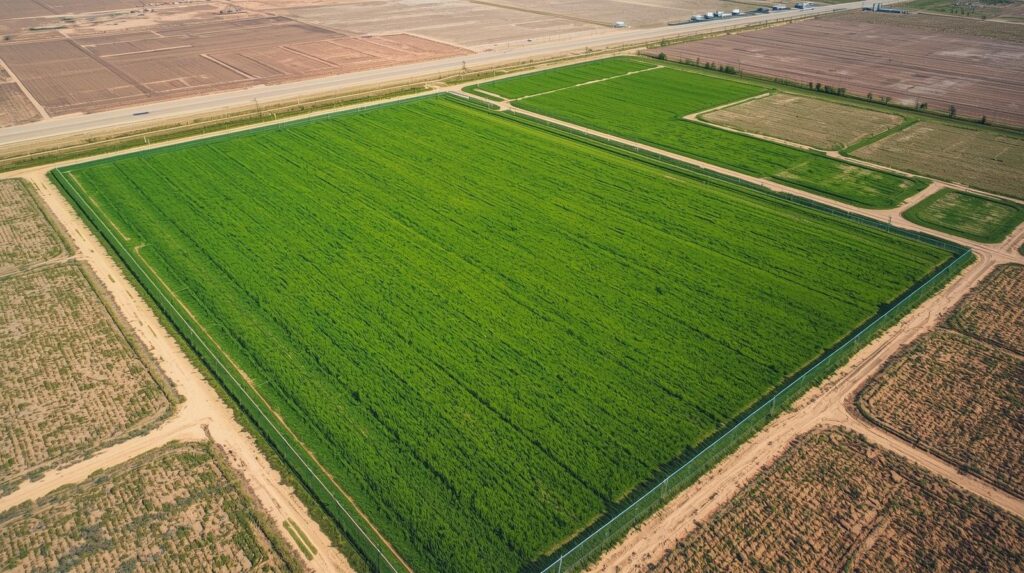
Before choosing an irrigation system, it is important to understand what grazing pasture requires in terms of water delivery. Unlike row crops or vegetables, pasture grass grows in a dense, uniform layer and must receive even water distribution across the entire field.
The ideal irrigation system for pasture should provide uniform coverage without creating dry patches or waterlogged areas. It should also support frequent watering cycles, as pasture grass requires consistent moisture to maintain growth and regrowth after grazing.
Water efficiency is another important factor, especially in dry climates. Excessive evaporation and runoff can significantly reduce the effectiveness of irrigation. Therefore, systems that simulate natural rainfall or deliver controlled water application tend to perform better.
Finally, the system should be easy to manage. Many small-scale farmers do not have access to advanced automation systems, so simplicity and durability are important considerations.
Sprinkler Irrigation as the Most Suitable Option
For a 1 hectare grazing pasture, sprinkler irrigation is generally considered the most suitable and balanced solution. This system distributes water through overhead sprinklers that simulate natural rainfall, making it ideal for grass growth.
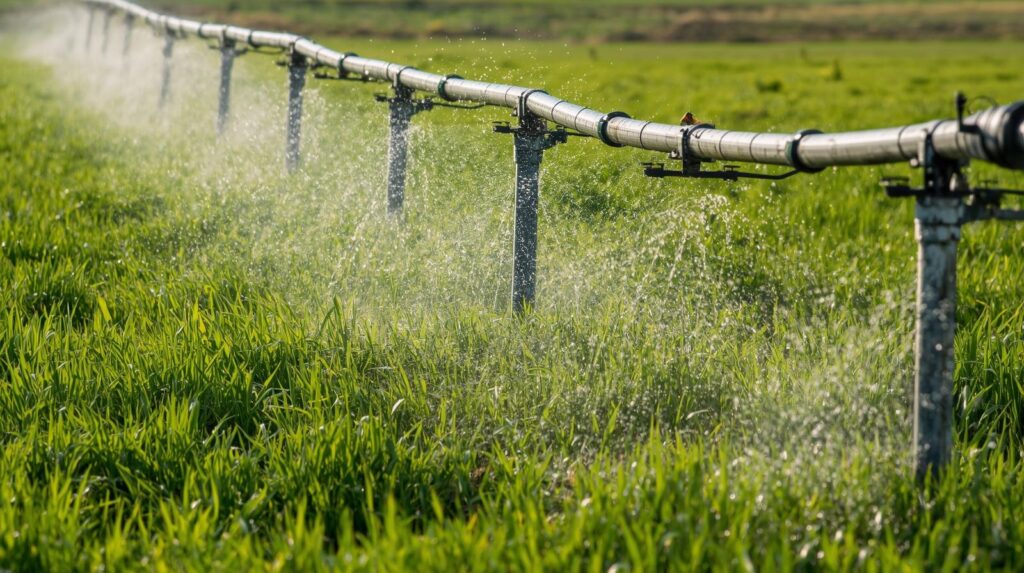
Sprinkler systems can be fixed or movable, depending on the farm layout and budget. Fixed systems use permanently installed sprinkler lines, while movable systems allow farmers to irrigate different sections of the pasture in rotation.
One of the main advantages of sprinkler irrigation is its ability to provide uniform water distribution. This ensures that all areas of the pasture receive adequate moisture, promoting even grass growth and maximizing grazing potential.
Another advantage is flexibility. Sprinkler systems can be adjusted to suit different soil types and water pressures, making them suitable for a wide range of farm conditions. They are also scalable, allowing farmers to expand the system in the future if needed.
However, sprinkler irrigation does have limitations. Wind can reduce efficiency by causing uneven water distribution, especially in open areas. There is also some water loss due to evaporation, particularly in hot climates. Despite these challenges, it remains one of the most practical options for small pasture systems.
Overall, sprinkler irrigation offers a strong balance between cost, performance, and ease of use, making it the leading choice for 1 hectare grazing pastures.
Drip Irrigation and Its Limitations for Pasture Systems
Drip irrigation is one of the most water-efficient irrigation methods available. It delivers water directly to the root zone of plants through a network of pipes and emitters. This reduces evaporation and ensures precise water application.
While drip irrigation is highly effective for crops such as vegetables and orchards, it is generally not suitable for grazing pasture. The main reason is that pasture grass requires uniform surface coverage rather than localized watering.
Installing drip lines across an entire hectare of grazing land is also expensive and difficult to maintain. In addition, livestock grazing on the land can easily damage the irrigation lines, leading to frequent repairs and maintenance costs.
Drip irrigation may be considered in specific cases where pasture is grown for cut-and-carry feeding systems rather than direct grazing. However, for open grazing systems, it is not the most practical choice.
Center Pivot and Mini Pivot Systems
Center pivot irrigation systems are commonly used in large-scale commercial farming operations. These systems consist of rotating sprinkler arms that cover circular fields efficiently.
For a 1 hectare pasture, full-scale pivot systems are generally not cost-effective. The infrastructure and installation costs are high, and the system is designed for much larger land areas.
However, smaller or mini pivot systems do exist and can be used in limited applications. These systems provide excellent water distribution and require less manual labor compared to other methods.
The main drawback is cost. Even smaller pivot systems can be expensive for small-scale farmers. They also require a consistent water supply and pressure system to operate effectively.
For farmers planning to expand into large-scale production in the future, pivot systems may be worth considering. However, for a single hectare pasture, they are often considered an overinvestment.
Hose Reel or Traveling Irrigation Systems
Hose reel irrigation systems are a lower-cost alternative that can be suitable for small pasture areas. These systems use a movable sprinkler attached to a hose that is pulled across the field either manually or mechanically.
One of the main advantages of this system is affordability. It requires less initial investment compared to fixed sprinkler or pivot systems. It is also flexible, allowing farmers to irrigate different sections of the pasture without permanent installation.
However, hose reel systems require more labor and management. The watering process is not fully automated, and uneven application can occur if the system is not carefully controlled. This can lead to inconsistent grass growth across the pasture.
Despite these limitations, hose reel systems can be a practical solution for farmers with limited budgets who still want to irrigate pasture land effectively.
Flood Irrigation and Its Suitability
Flood irrigation is one of the oldest irrigation methods and involves distributing water across the field through channels or surface flooding. While it is simple and inexpensive to set up, it is not well suited for grazing pastures in dry climates.
The main disadvantage of flood irrigation is water inefficiency. A significant amount of water is lost through evaporation and runoff. In addition, water distribution is often uneven, leading to patchy pasture growth.
In regions such as Namibia, where water is scarce, flood irrigation is generally not recommended for pasture production. It may only be viable in areas with abundant water supply and suitable soil conditions.
Recommended Irrigation System for 1 Hectare Pasture
After evaluating the different irrigation options, sprinkler irrigation stands out as the most suitable system for a 1 hectare grazing pasture. It provides a good balance between cost, efficiency, and ease of use.
Sprinkler systems are particularly effective because they mimic natural rainfall, which is ideal for pasture grass. They also offer flexibility in design and can be adapted to different farm layouts.
For farmers with very limited budgets, hose reel systems may serve as a temporary or alternative solution. However, for long-term pasture development, sprinkler irrigation provides better consistency and reliability.
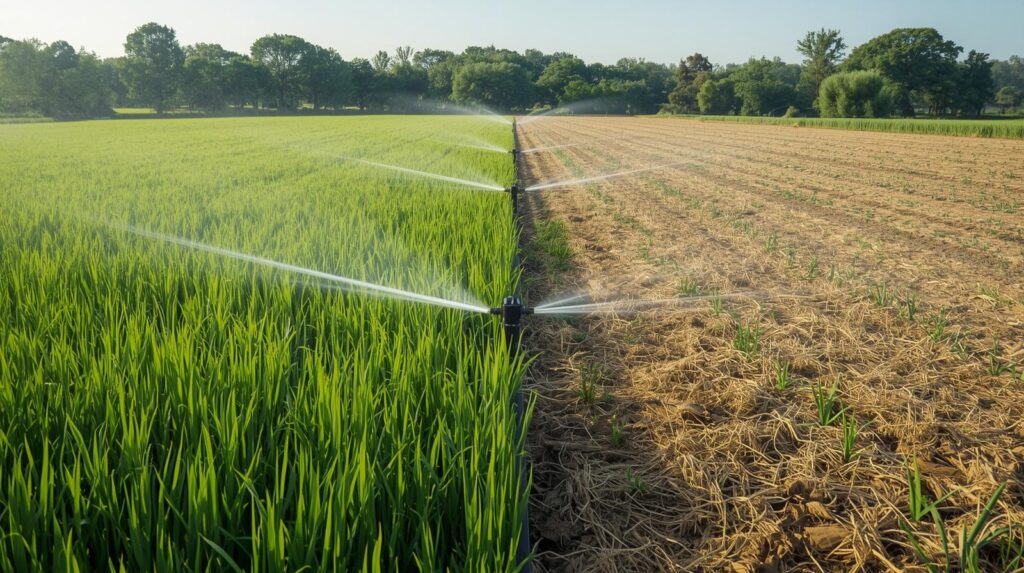
Selecting the best irrigation system for a 1 hectare grazing pasture requires careful consideration of water availability, cost, and operational efficiency. In most cases, sprinkler irrigation offers the most practical and balanced solution, especially in dry regions such as Namibia.
While other systems such as drip irrigation, pivot systems, and flood irrigation have their advantages, they are either too expensive, too inefficient, or not suitable for grazing land. Sprinkler irrigation remains the most widely applicable option for small pasture systems due to its ability to provide even coverage and support healthy grass growth.
Ultimately, successful pasture irrigation is not just about choosing a system, but also about proper management and maintenance. With the right setup and consistent care, a 1 hectare grazing pasture can become a highly productive and sustainable source of livestock feed. For more info, check out FAO.
Read more from us on our site.